My research group will integrate methods from continuum mechanics, statistical mechanics, and electrochemistry to advance our physical understanding of bioelectricity and its control, providing a theoretical and computational foundation for future developments in neurotherapeutics, bioelectronics, and soft energy materials.
I have developed theoretical and computational approaches to link microscopic dynamics to emergent behavior in nonequilibrium systems, with a focus on active matter and neuronal membranes.
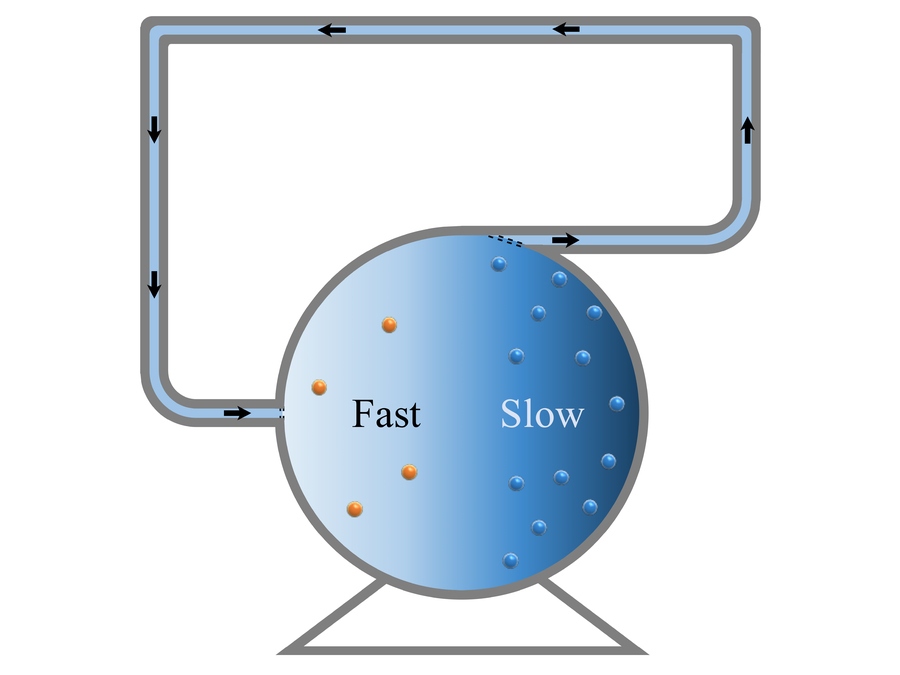
Active matter converts energy into motion at the microscopic scale, driving it out of equilibrium and enabling collective behaviors with no equilibrium counterpart. A striking example is motility-induced phase separation (MIPS), in which even purely repulsive particles separate into dense and dilute phases simply because they self-propel:
How do we describe nonequilibrium phase coexistence?
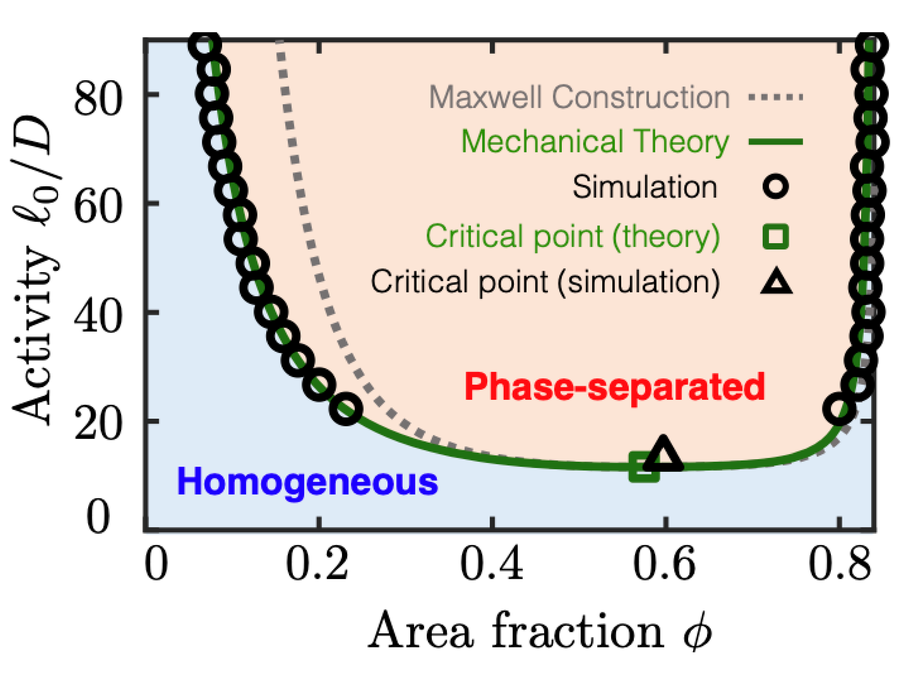
Phase coexistence is usually described by equilibrium conditions based on free energy and chemical potential, but these do not directly apply to systems driven out of equilibrium. Using statistical mechanical methods to bridge individual particle dynamics and continuum descriptions, I developed a mechanical framework that replaces thermodynamic coexistence conditions with momentum balances that remain valid both in and out of equilibrium. Applied to active matter, this framework explains MIPS phase behavior, including its interfacial structure and suppression under confinement, and reveals a reverse osmotic effect.
Life runs on ionic currents across membranes, from neuronal signaling and muscle contraction to ATP synthesis. Although these currents are carried by individual ion channels, conventional equivalent-circuit models describe the membrane phenomenologically as a lumped electrical element, leaving the molecular elements and electrochemical dynamics underlying electrophysiology unresolved.
How does individual ion channel activity build into neuronal signals?
Single channel activity generates a rapid electrical signal.
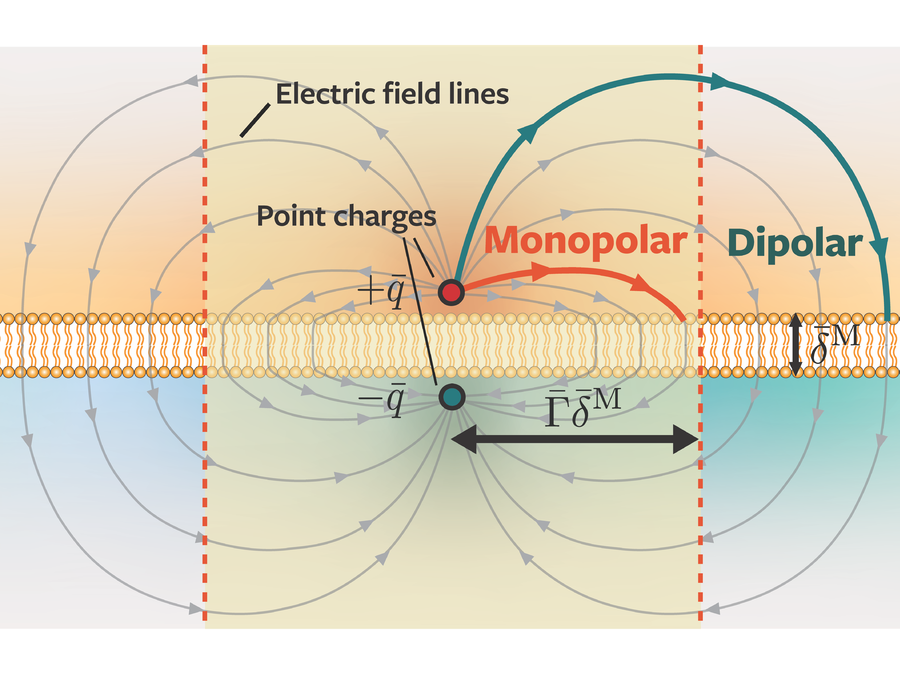
To understand the effects of current through an individual channel, I developed a continuum theory of electrochemical dynamics generated by single channel activity. The theory shows that a localized current through an open channel reorganizes charge and electric potential via long-range electric fields. The resulting electrical signal propagates at about 40 m/s, far exceeding the speed attainable by bare diffusion.
Multiple channels can exhibit a bioelectric phase transition.
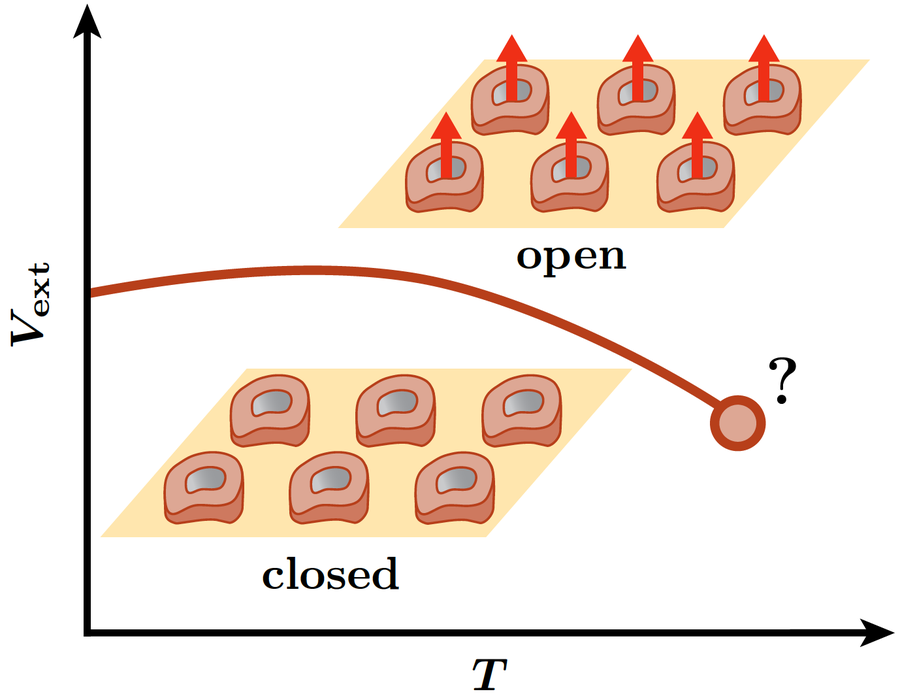
The electrical signals generated by individual channels can mediate effective interactions between them. Building on the single channel theory, I formulated a statistical mechanical model of interacting voltage-gated ion channels. The model reveals that a dense collection of ion channels can undergo a first-order transition between closed- and open-dominated states, suggesting a physical mechanism underlying collective activation in neuronal membranes.
In multiphase transport models, adjoining phases are often assumed to remain equilibrated at the interface, with resistance to mass transfer attributed primarily to diffusion through the bulk phases. Yet this assumption becomes questionable at microscales, where large surface-to-volume ratios can make interfacial effects more pronounced.
Interfaces can control mass transport at microscales.
Using linear irreversible thermodynamics, I showed that interfacial mass transfer resistance relates mass flux to a chemical-potential jump across interfaces, analogous to slip length and Kapitza resistance in momentum and heat transfer. This resistance can make concentration relaxation at small scales interface-limited, with dynamics controlled by interfacial rather than bulk transport. In close collaboration with Kevin Wilson’s group, we measured interfacial resistance in microfluidic droplets, establishing it as a control parameter for microscale multiphase transport.


With extensive training across chemical engineering, physics, and applied mathematics, I am excited to teach a broad range of courses, including thermodynamics, transport phenomena, statistical mechanics, continuum mechanics, soft matter, electrochemistry, numerical methods, and computer simulations. I am also eager to develop undergraduate and graduate electives on bioelectricity that help students connect physical principles to emerging problems in soft and living matter, electrochemical technologies, bioelectronics, cellular engineering, and neuroscience.
As large language models reshape education, I am deeply interested in using these tools thoughtfully and efficiently in both teaching and learning. I believe their effective use demands the physical reasoning at the core of theoretical training: identifying implicit assumptions, formulating well-defined problems, and judging whether an answer is meaningful. As a theorist, I see an opportunity to design course content, pedagogy, and assessment that cultivate this mode of thinking.